Wireless First: The Future of Campus Connectivity
The Post-Cabling Era: Designing a Wireless-First Higher Ed Campus
For decades, the standard for campus connectivity was "Fiber to the Room" or "Edge Switching." In 2026, the paradigm has shifted. Students and faculty no longer want to be tethered to a desk; they expect a seamless, multi-gigabit experience whether they are in a lecture hall, a research lab, or sitting on the campus quad. A "Wireless First" strategy is more than just adding more access points—it is a total redesign of the campus network backbone to prioritize mobility, density, and extreme reliability. In this expanded guide, we explore the engineering required to build the campus of the future.
1. WiFi 7 and the 6GHz Frontier: Multi-Link Operation (MLO)
While WiFi 6E opened the 6GHz "superhighway," WiFi 7 (802.11be) is the technology that truly enables Wireless-First. The most critical feature for a campus environment is Multi-Link Operation (MLO). Previously, a device could only talk to an access point on one band at a time (e.g., 5GHz or 6GHz). If that band became congested, the device would throttle.
With WiFi 7, a student's laptop can use multiple bands simultaneously to transmit data. This results in aggregate speeds of over 10Gbps and, more importantly, "Ultra-High Reliability." In a dense student union where thousands of devices are competing for airtime, MLO ensures that critical applications—such as proctored online exams or VR-based surgical simulations—never lose their connection.
2. Backbone Engineering: The Importance of XGS-PON Fiber
You cannot have a multi-gigabit wireless network without a multi-gigabit fiber backbone. Traditional 1Gbps or 10Gbps copper uplinks are the bottleneck of 2026. Srifal Technologies implements XGS-PON (10-Gigabit Symmetrical Passive Optical Network) architecture for campus backhaul. This allows we to run a single fiber string to an entire wing of a building and provide dedicated, non-blocking 10Gbps capacity to every cluster of access points. This reduces the need for massive, heat-generating switch closets and simplifies the power requirements (PoE++) for high-density deployments.
3. Outdoor Connectivity: The "Classroom Without Walls"
Modern pedagogy often happens outside the traditional classroom. We extend the "Wireless First" experience to the entire campus footprint using:
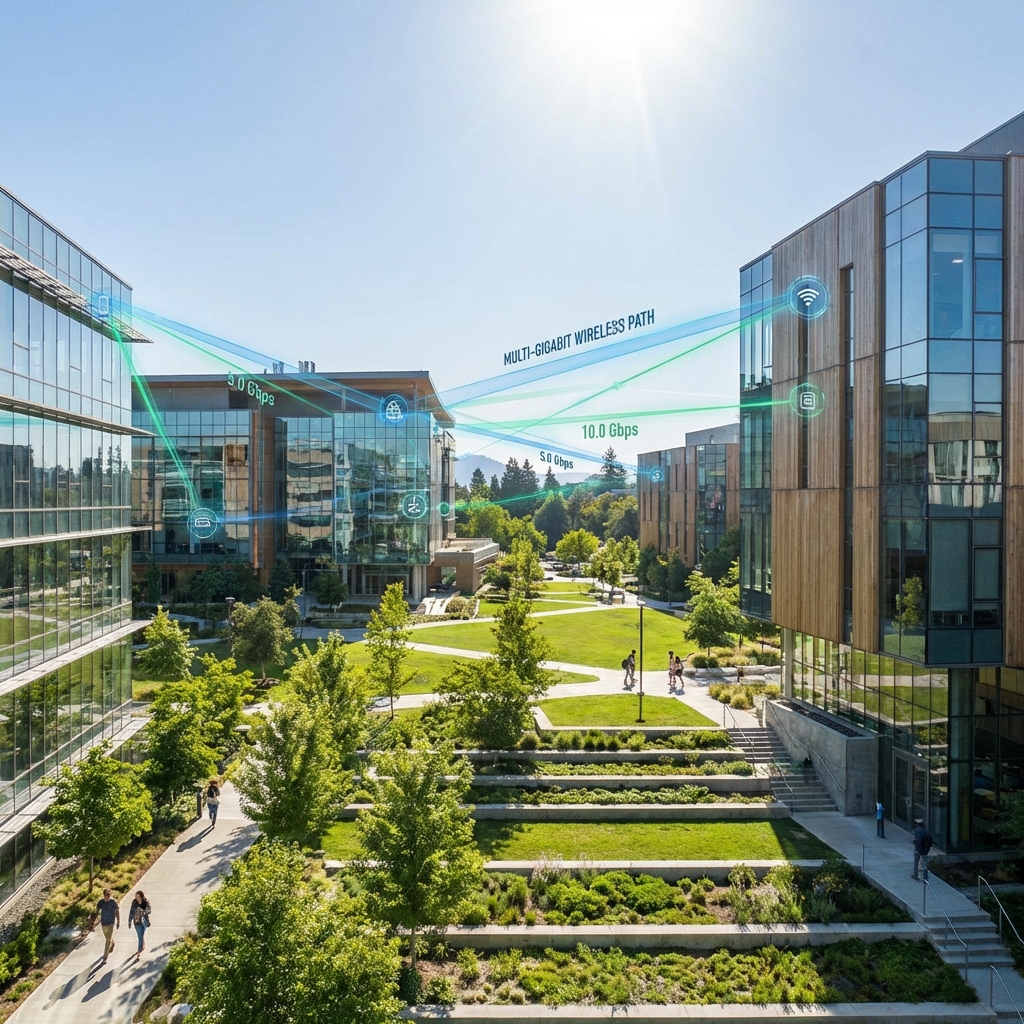
- High-Impact Mesh: Creating high-speed wireless bridges between buildings where trenching fiber is cost-prohibitive.
- Pole-Mounted Small Cells: Integrating micro-antennas into lamp posts and campus signage to provide pervasive 5G and WiFi coverage in open quads and athletic fields.
- Point-to-Multipoint (PtMP): Using 60GHz wave technology to provide fiber-like speeds to remote research outposts or student housing complexes.
4. IoT and the Smart Campus Ecosystem
A Wireless-First network is also the nervous system for the "Smart Campus." We integrate secondary IoT layers that benefit both students and administrators:
- Wayfinding & Positioning: Helping new students navigate complex buildings using blue-dot navigation on their smartphones (accurate to within 1 meter).
- Smart Lighting & HVAC: Using network-connected sensors to optimize energy usage based on real-time classroom occupancy data.
- Digital Signage & Security: Managing campus-wide emergency alerts and 4K wireless security cameras over a dedicated, segmented IoT channel.
5. The 5-Phase Transition Strategy
Moving a 50-year-old campus to a Wireless-First model requires a surgical approach:
- RF Propagation Study: We perform a comprehensive outdoor and indoor RF audit, mapping signal penetration through historic stone and brick structures.
- Core Virtualization: Moving the network "brains" to a centralized, software-defined controller to allow for instant campus-wide policy updates.
- High-Density Overlay: Prioritizing auditorium and library clusters where device density is highest.
- Legacy Phase-Out: Gradually removing localized ethernet drops and repurposing those budget dollars toward pervasive wireless coverage.
- Analytics Integration: Using AI-driven dashboards to monitor traffic patterns and proactively adjust bandwidth allocation during major events (e.g., graduation or homecoming).
6. Case Study: The Urban University Transformation
A major urban university with over 40,000 students faced constant WiFi complaints in their older residence halls. Srifal Technologies implemented a WiFi 6E overlay combined with a Private LTE network for "Outdoor Anchor" coverage. The result was a 65% reduction in help desk tickets and a 3-fold increase in average student data consumption, proving that the demand for "Wireless First" was always there—the infrastructure just had to catch up.
7. FAQ for Campus CIOs
Q: Will WiFi 7 interfere with our research equipment?
A: No. WiFi 7 allows for "Puncturing," which can carve out specific frequencies used by sensitive lab equipment while still using the rest of the 320MHz channel for data.
Q: How do we handle guest access for 10,000 visitors during a game?
A: We design "Elastic Guest Segments" that can dynamically expand their bandwidth pool based on real-time authentication volume, ensuring that visitors stay connected without impacting student research traffic.
Consult with Srifal Technologies to begin your campus's transition to a Wireless-First architecture. We provide the engineering depth and project management expertise needed to turn your campus into a global leader in connectivity.