Public Safety Connectivity: A 2026 Compliance Guide
Ensuring Compliance in Emergency Communications: The 2026 Essential Guide
Public safety connectivity is no longer just a technical consideration; it is a critical regulatory pillar for modern property management. In 2026, obtaining and maintaining a Certificate of Occupancy (CO) is inextricably linked to the performance of your Emergency Responder Radio Enhancement System (ERRCES). In this expanded guide, we break down the engineering, legal, and operational nuances of keeping your building safe and compliant.
1. What is ERRCES? The Invisible Shield for First Responders
When firefighters, police officers, or paramedics enter a complex structure during an emergency, their lifecycle depends on communication. However, the very materials that make buildings strong and energy-efficient—concrete, steel, and low-E glass—are the enemies of radio waves. These materials can attenuate (weaken) outside public safety radio signals to the point of total failure.
An ERRCES (often referred to as a BDA System) is a life-safety building system designed to rectify this. It consists of a donor antenna on the roof that captures signals from the city's radio towers, a Bi-Directional Amplifier (BDA) that boosts those signals, and a Distributed Antenna System (DAS) that radiates the signal into every corner of the building, including "shielded" areas like stairwells, elevator lobbies, and underground parking decks.
2. Navigating the 2026 Code Landscape: NFPA vs. IFC
Compliance is governed by two primary bodies of standards, which are then adopted and often modified by the local Authority Having Jurisdiction (AHJ):
- NFPA 1221 / NFPA 1 (National Fire Protection Association): Focuses heavily on the technical standards for signal strength, survivability, and systemic monitoring.
- IFC 510 (International Fire Code): Mandates the presence of radio coverage in new and existing buildings, defining the specific areas (e.g., critical areas vs. general areas) where coverage is required.
In 2026, the specific threshold for "Critical Areas" (stairwells, fire pump rooms, exit paths) has been raised from 95% coverage to 99% coverage. General areas (offices, lobbies) typically require 90% coverage. These measurements must meet a minimum signal strength of -95 dBm throughout the grid.
3. The "Survivability" Requirement: 2-Hour Protection
One of the most significant engineering challenges in 2026 is the "Survivability" mandate. A public safety system must function even while the building is actively on fire. This requires:
- Fire-Rated Cabling: All backbone cabling (risers) must be housed in a 2-hour fire-rated enclosure or consist of 2-hour fire-rated coaxial cable.
- NEMA 4/4X Enclosures: All active components (amplifiers, power supplies) must be housed in pressurized, water-resistant enclosures to protect against sprinkler activation and fire department hose streams.
4. The Engineering Workflow: From Design to AHJ Acceptance
At Srifal Technologies , we follow a rigorous 5-phase engineering process:
- Benchmark Testing: We divisions the building into a 20-grid or 40-grid pattern per floor and test the existing signal. If the building fails in more than 10% of the grids, a system is legally required.
- iBwave Modeling: We create a 3D digital twin of your building's RF environment, simulating antenna placement to ensure 100% compliance before a single hole is drilled.
- Installation & Commissioning: Our factory-certified technicians install the BDA, donor antenna, and battery backups, ensuring that "uplink noise" is minimized to avoid interfering with the city's radio network.
- ATP (Acceptance Test Procedure): We perform a final grid test alongside the local fire marshal or AHJ, providing a detailed report of signal-to-noise ratios and signal strength.
- Annual Certification: Code requires that the system be tested every 12 months. We provide a managed service that handles the technical testing and the submission of documentation to the local fire department.
5. The Near-Far Problem: Why "DIY" is Dangerous
A poorly designed BDA system is worse than no system at all. If an amplifier is not correctly calibrated, it can "blow back" noise into the public safety tower, potentially shutting down first responder communications for several blocks. This is known as the "Near-Far" interference problem. Building owners are legally liable for any interference caused by their systems. This is why using an FCC-licensed and factory-certified engineering firm like Srifal Technologies is non-negotiable.
6. Life-Cycle Management and Battery Backups
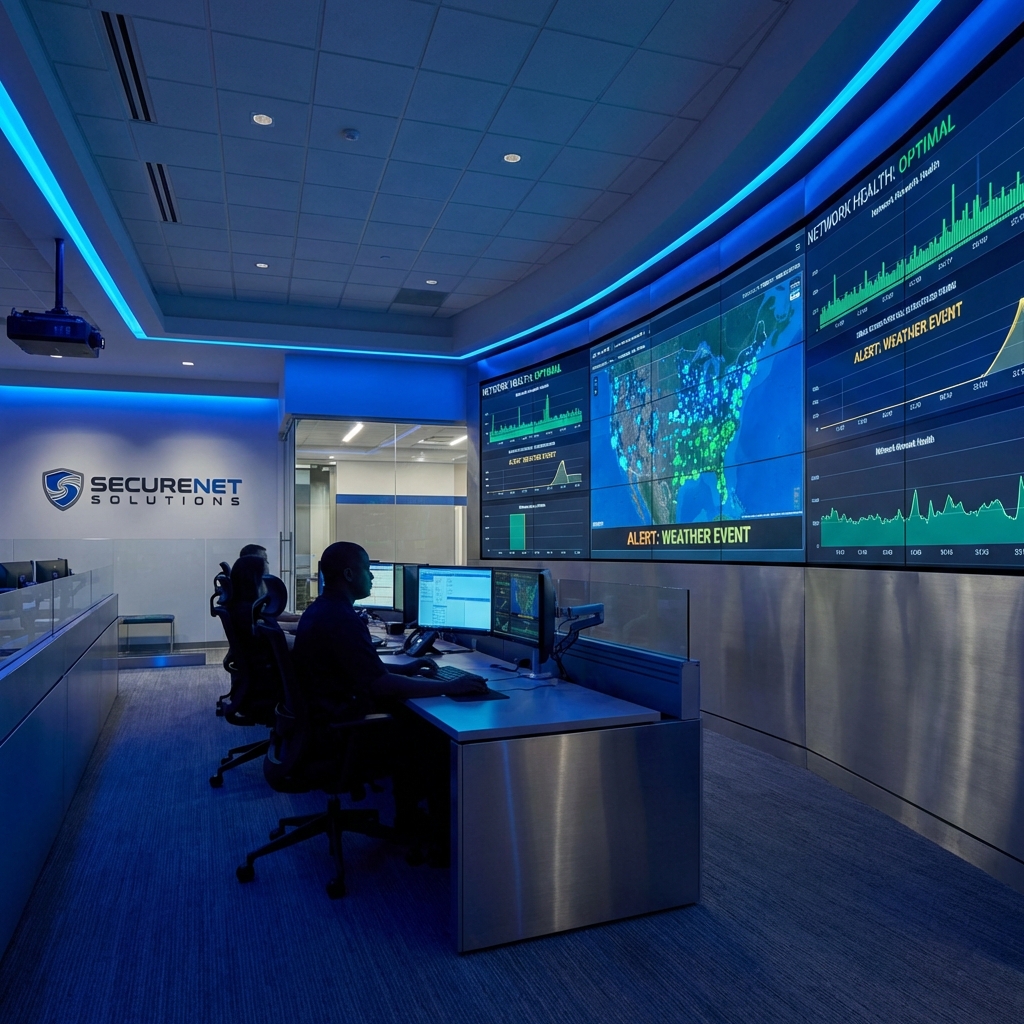
Code mandates that an ERRCES must have 24 hours of autonomous power in the event of a total building power failure. We utilize high-capacity LiFePO4 battery systems that are monitored 24/7. Our NOC receives an immediate alert if a battery is discharging or if the system has been tampered with, ensuring that you are never "at risk" during a surprise inspection.
7. Common Compliance Pitfalls
- Unmonitored Alarms: Failure to connect the BDA alarms (AC fail, Battery fail, BDA fail) to the building's fire alarm control panel.
- Inadequate Donor Isolation: Installing the roof antenna too close to the internal antennas, causing "feedback loop" oscillation.
- Documentation Gaps: Losing the original iBwave design files or previous years' test results, which AHJs increasingly demand to see during audits.
8. 5-Year Compliance Outlook
As 2030 approaches, we expect to see the integration of Public Safety over 5G (FirstNet) into the ERRCES code requirements. Srifal Technologies is already designing "Dual-Band" systems that support both traditional P25 radio and modern 700MHz/800MHz LTE public safety bands, ensuring your investment is future-proofed for the next decade.
Consult with Srifal Technologies to schedule a benchmark test of your facility. Whether you are in the pre-construction phase or managing an existing portfolio, our team ensures your compliance is absolute and your building is safe.