Modernizing K-12 Connectivity: Beyond Basic WiFi
Learning Without Limits: Bridging the Digital Divide in K-12 Districts
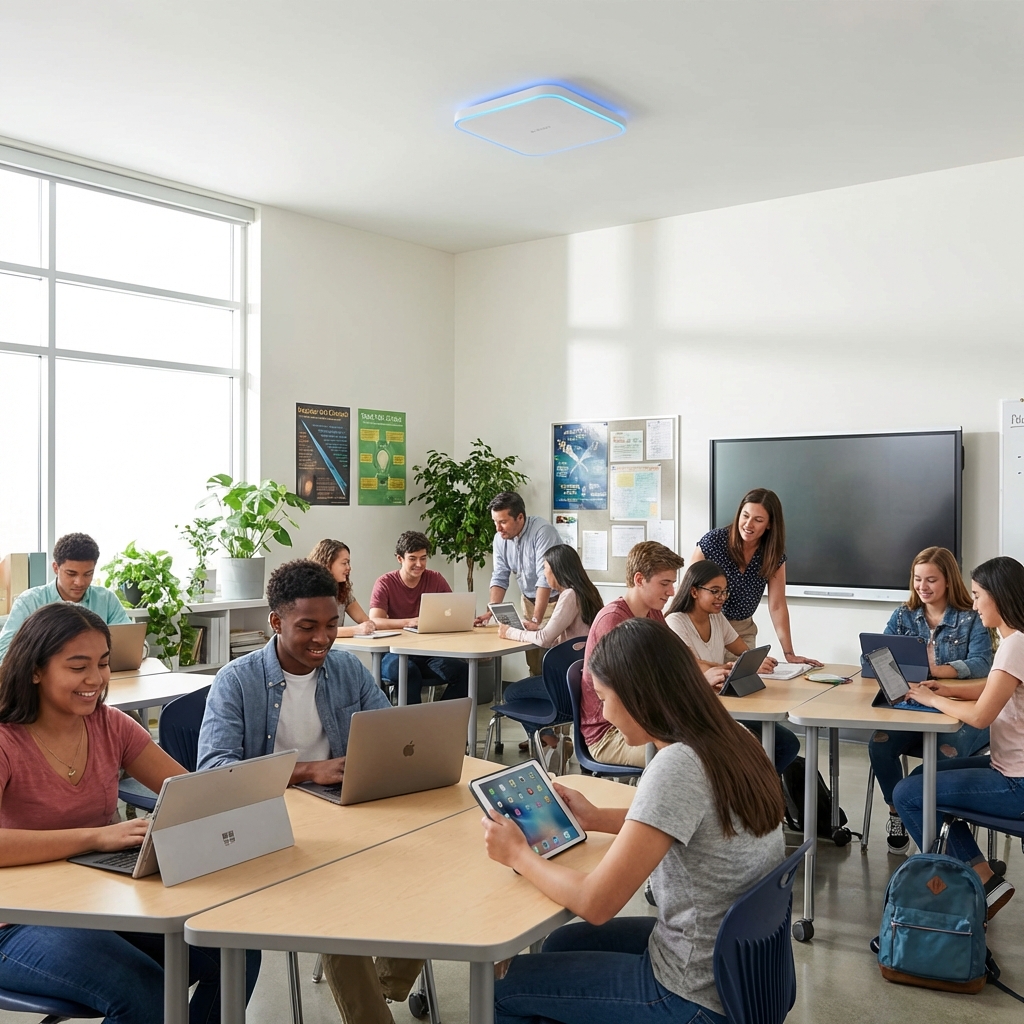
The modern classroom is a high-density, digital-first environment that requires a fundamental rethinking of network architecture. With 1:1 laptop initiatives, interactive smartboards, and cloud-based learning platforms (LMS), schools require enterprise-grade wireless that can handle hundreds of concurrent video streams without a single packet drop. In this expanded guide, we explore how school districts are leveraging new technologies and federal funding to modernize their connectivity for the 2026-2027 academic year.
1. The High-Density Challenge: Beyond the Hallway
A typical high school classroom today is a denser RF environment than a corporate office. You have 30 students, each with a laptop and a smartphone, plus a teacher's workstation and an interactive display. In a single hallway with 10 classrooms, you might have 600-800 devices trying to access the same few access points. This "density crunch" is the primary cause of slow connectivity in schools.
Srifal Technologies addresses this through precise RF planning using the 6GHz band (WiFi 6E). By utilizing these uncongested channels, we can provide wider bandwidth (80MHz or 160MHz channels) specifically for educational devices, while keeping internal district traffic on the 5GHz band. This ensures that a student watching a high-definition laboratory simulation doesn't slow down the teacher's ability to input attendance data.
2. Maximizing E-Rate: The Financial Engine of Modernization
The federal E-Rate program is a baseline requirement for school infrastructure, providing discounts of up to 90%. However, many districts fail to maximize their Category Two funding due to complex application requirements or choosing non-eligible solutions.
We act as a technical partner for your E-Rate coordinator. Our designs specifically prioritize Category Two eligible equipment—routers, switches, managed internal broadband services, and access points. By aligning our engineering with E-Rate timelines, we help districts refresh their entire hardware stack every 5 years with minimal impact on the general fund. We also provide the mandatory "Letter of Agency" and technical documentation required for the Form 470 and 471 filings.
3. Private LTE (CBRS): Extending the School Network to the Home
The "Homework Gap" refers to students who cannot complete digital assignments because they lack reliable internet at home. To bridge this divide, forward-thinking districts are now deploying Private LTE networks using the CBRS band. By placing a compact outdoor small cell on the school roof or a nearby water tower, the district can provide free, secure, and CIPA-filtered internet access to student homes throughout the community.
This is not public Wi-Fi; it is a private network that requires a district-issued SIM card. This ensures that only school-authorized devices can connect, and all traffic is routed through the district's web filters, keeping students safe online even when they are off-campus.
4. Safety and Security: The Campus Network as a Lifeline
In 2026, network reliability is a matter of campus safety. Our designs include:
- Physical Security Segments: We isolate IP security cameras and door access controllers into a high-availability segment with mirrored backup paths.
- Priority for First Responders: We implement QoS (Quality of Service) rules that automatically prioritize emergency communication traffic during a crisis.
- CIPA Compliance: We integrate next-generation firewalls that use AI-driven content filtering to block inappropriate content in real-time without slowing down legitimate educational research.
5. The Roadmap to a Multi-Gigabit Campus
We work with districts to implement a 4-phase modernization roadmap:
- Infrastructure Audit: Testing existing CAT6/CAT6A cabling to ensure it can support 2.5Gbps or 5Gbps PoE (Power over Ethernet) for WiFi 6E APs.
- Core Upgrade: Upgrading the MDF (Main Distribution Frame) with 10Gbps/40Gbps fiber links to provide a high-capacity backbone.
- Managed Deployment: Rolling out access points during school breaks to minimize instructional disruption.
- NOC Integration: Connecting the school network to our 24/7 monitoring center to identify hardware failures before students arrive on Monday morning.
6. Technical FAQ for School IT Leaders
Q: Is WiFi 6E worth the upgrade for older buildings?
A: Yes. The 6GHz band is far superior at penetrating internal glass and wood partitions found in older schools, and it completely eliminates interference from non-educational Bluetooth devices.
Q: How do we manage the SIM cards for Private LTE?
A: We use eSIM (Embedded SIM) technology wherever possible. For older devices, we provide physical SIMs that are pre-configured for your district's private network.
"Instructional technology is only as good as the network it runs on. A great teacher with a slow network is like a race car driver in a traffic jam."
Consult with Srifal Technologies to design a connectivity roadmap for your school district that maximizes E-Rate funding and ensures no student is left behind in the digital age.