The Evolution of 5G in Modern Smart Buildings
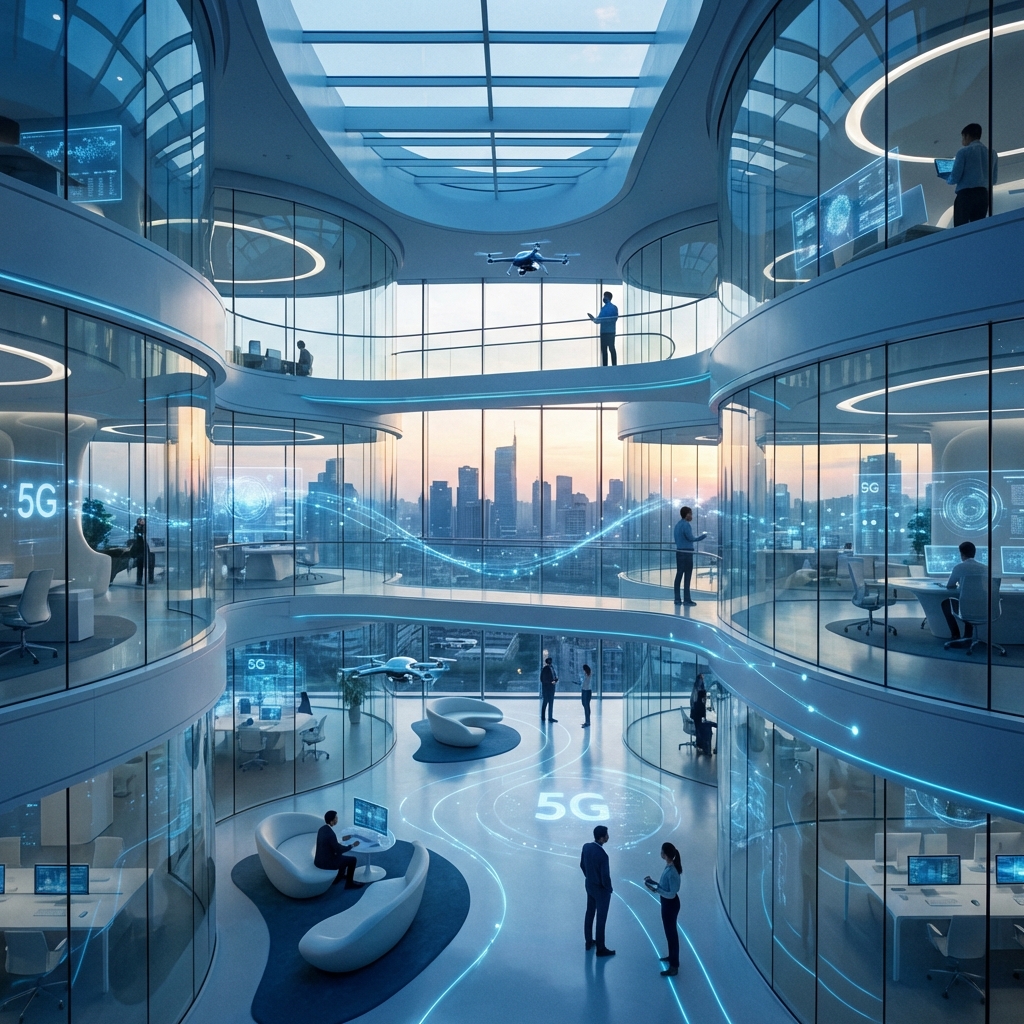
The New Standard for In-Building Connectivity
Traditional indoor wireless solutions are no longer sufficient for the demands of modern tenants. As 5G becomes the global standard, smart building owners are increasingly looking towards integrated DAS and Small Cell solutions to provide the high-speed, low-latency connectivity that businesses require. In this comprehensive analysis, we explore why 5G is not just an upgrade, but a fundamental shift in commercial real estate value and human-building interaction.
1. The Physics of 5G: Why Indoor Engineering is Harder Than Ever
Implementing 5G within a high-rise or a multi-tenant commercial building is a complex engineering feat that defies simple solutions. It involves significantly more than just swapping out 4G antennas. The primary challenge lies in the physics of high-frequency radio waves. The higher frequency bands used by 5G, particularly Millimeter Wave (mmWave) in the 24GHz-39GHz range, offer incredible bandwidth but have an extremely limited physical range and almost zero penetration through solid objects.
Modern building codes have unintentionally made this problem worse. Low-E glass, designed to reflect heat and UV rays for energy efficiency, effectively acts as a Faraday cage, reflecting or absorbing external 5G signals before they can even enter the lobby. Concrete, steel rebars, and even the human body itself act as significant attenuators for high-frequency signal propagation.
Engineers at Srifal Technologies utilize advanced ray-tracing RF modeling software to map out the "dead zones" within a structure down to the decibel. We look at the building's physical materials—from the dielectric constant of the drywall to the density of the furniture. A robust 5G system typically combines a centralized signal source with a massive network of remote units distributed throughout the floors. This is known as a high-density Distributed Antenna System (DAS).
Beyond simple signal strength (RSSI), we must også measure Signal-to-Interference-plus-Noise Ratio (SINR). In a dense urban environment, signals from neighboring buildings can create "interference clouds" that degrade 5G performance even if the signal is strong. Our designs utilize beamforming technology to steer signals precisely where they are needed, minimizing interference and maximizing throughput.
2. Spectrum Strategy: Millimeter Wave vs. Sub-6 GHz
One of the most common questions from building owners is which 5G band they should prioritize. To understand this, we must look at the two primary "flavors" of 5G:
- Sub-6 GHz (Low and Mid-Band): This spectrum offers a balance between speed and coverage. It provides better penetration and carries a signal further across large floor plates. It is the "anchor" for connectivity, ensuring that workers have a solid connection even in internal stairwells or elevators.
- mmWave (High-Band): This is where 5G's "magical" speeds reside (up to several Gbps). However, mmWave requires a direct line-of-sight to the antenna. It is highly directional. We deploy mmWave specifically in high-impact zones: auditoriums, trading floors, and high-tech conference suites where massive data throughput is non-negotiable.
For true smart buildings, a hybrid approach is mandatory. We design a "Mid-Band First" layer for ubiquitous connectivity and "High-Band Spot" layers for performance-critical zones. This multi-layered architecture ensures that the building is ready for both general office use and specific high-bandwidth industrial or medical applications.
3. The Rise of O-RAN (Open Radio Access Network)
Historically, building owners were locked into proprietary hardware from a single vendor (e.g., Nokia or Ericsson). If you wanted to upgrade one part of the system, you had to replace everything. O-RAN is changing the economics of indoor 5G. By using open standards, building owners can "mix and match" the best radios with the best baseband processing units. This "disaggregation" of the network significantly reduces CAPEX and allows for software-defined upgrades. Srifal Technologies is a leader in O-RAN integration, ensuring that our clients are never held hostage by a single hardware manufacturer.
4. The Economic Impact: Connectivity as the Fourth Utility
Connectivity has officially transitioned from a "tenant perk" to a "mission-critical utility," sitting alongside water, electricity, and HVAC. In the post-pandemic commercial real estate market, tenants are significantly more discerning. They often conduct "signal audits" of potential office space before ever looking at the floor plan.
Statistical data from 2024 and 2025 indicates that buildings with "Certified 5G Readiness" or an active Neutral-Host DAS can command lease premiums of 10-15% over neighboring properties with dead zones. It also attracts high-value, tech-dependent tenants in the finance, bio-pharma, and AI sectors. For these firms, a 100ms lag in their wireless network can translate into millions of dollars in lost opportunity. By providing a carrier-grade environment, building owners are essentially providing a "data insurance policy" for their tenants.
5. ESG and Sustainable Connectivity
Environmental, Social, and Governance (ESG) criteria are now central to commercial real estate investment. A 5G-enabled smart building is inherently more sustainable. High-speed, low-latency connectivity allows for the deployment of thousands of secondary sensors that monitor energy, water, and waste in real-time. By optimizing building systems based on actual occupancy rather than fixed schedules, a 5G smart building can reduce its carbon footprint by up to 25%.
6. The Smart Building Ecosystem: IoT and Operational Efficiency
A robust 5G foundation is the prerequisite for the "Cognitive Building." When you have a low-latency, high-device-density network, you can deploy secondary sensors at a scale that was previously impossible. This includes:
- Real-time Occupancy Tracking: Optimizing HVAC and lighting based on actual room usage, leading to OPEX reductions of up to 30%.
- Digital Twins: Creating a real-time virtual model of the building's mechanical systems for predictive maintenance.
- Automated Security: High-definition wireless video monitoring and biometric access control that operates without traditional cabling bottlenecks.
These technologies don't just save money; they create a superior tenant experience. Imagine an office that knows your temperature preferences and automatically adjusts the blind as you walk into a conference room—all enabled by 5G positioning technology.
7. Future-Proofing: Architecture for 6G and the AI Era
While 5G is the current frontier, Srifal Technologies designs with "Legacy-Free" principles. This involves a heavy investment in the "Fiber backbone." We run dedicated single-mode fiber to every Remote Unit (RU) location, often installing double the required capacity to account for future "Dark Fiber" needs. This allows for a simple "radio swap-out" in the future when 6G or newer standards emerge, without the need to tear open walls or ceilings again.
8. Technical FAQ for Facility Managers
Q: Does 5G interfere with our existing Wi-Fi?
A: No. 5G operates in dedicated licensed spectrum that is entirely separate from the 2.4GHz, 5GHz, and 6GHz bands used by Wi-Fi. In fact, a good 5G deployment often improves Wi-Fi performance by offloading mobile device traffic from the local network.
Q: Is there a limit to how many carriers can use the system?
A: Our Neutral-Host DAS designs are "Carrier Agnostic." This means Verizon, AT&T, and T-Mobile can all use the same internal antenna infrastructure, reducing the visual clutter of having multiple systems.
9. The Hudson Yards Case Study: A Blueprint for Success
In one of the most successful urban deployments, a major developer integrated a multi-operator DAS during the construction phase of a million-square-foot tower. By treating wireless as a core engineering discipline (rather than an IT afterthought), they were able to hide $2M in cabling costs through architectural integration. The building opened with 100% wireless coverage in every elevator cab and sub-basement, resulting in the fastest lease-up in the developer's history.
10. Your 15-Year Future Connectivity Roadmap
- Years 1-2: Implementation of Neutral-Host 5G DAS and Sub-6 GHz saturation.
- Years 3-5: Expansion of mmWave into high-impact conference and trading zones.
- Years 6-8: Full integration of IoT digital twins for HVAC and energy optimization.
- Years 9-12: Migration to O-RAN based software-defined radio cores.
- Years 13-15: Preliminary 6G hardware readiness and Tera-Hertz (THz) small cell pilot projects.
Consult with Srifal Technologies to transition your property from a "static structure" to a "dynamic 5G powerhouse." Our engineering team provides the end-to-end expertise required to turn connectivity into a competitive advantage.